
If you fell in love with cards during the Chris Moneymaker era, when he shock-waved the world with a $39 Saturday ticket entry fee into the WSOP Main Event, you remember what the golden age of poker felt like. Tables were loud, chat boxes were completely unhinged, and the games were played purely by raw human psychology. If you could spot a nervous betting pattern and had enough guts to take some action based on a basic pot odds understanding, you could probably print money from your desktop computer.
Fast forward to today. If you’re thinking of getting back into poker after a long hiatus and logging into one of the major public networks, you may find it to be an absolute brick wall. This isn’t like a card room anymore. It looks like a video game simulation.
Many veteran players will say that getting back into poker in 2026 requires a totally different approach than the one they used to play on mainstream corporate grids. The game hasn’t become untangled, but the environment has completely changed.
Here is a blunt, honest look at how classic boom-era approaches get swallowed whole by modern public networks, why burying yourself in software is a dead-end street, and how to find the soft, psychological games you actually miss.
Getting Back Into Poker – Key Tips
Why Comparing Old-School Play to Modern Online Grids Feels Like Culture Shock for Returning Vets in 2026

When you compare the old-school style of play to current-day online grid players, the biggest surprise isn’t that people are playing more aggressively. It’s that all of humanity has been removed from the framework of the game. These days, public desktop lobbies are not casual cardrooms. They are hyper-optimized environments packed with neon avatars, interactive emojis, and automated tracking metrics.
For anyone getting back into poker today, the level of competition on public sites is almost too much to handle:
- The death of intuitive calls: In 2003, even casual players would call three streets with middle pair just to see what happens. Today, even low-stakes public regulars know basic hand ranges and basic defense frequencies.
- The rise of the multi-tabling machine: You no longer face off against the eccentric hobbyist playing one table. Now you play against grinders playing four to eight tables concurrently, executing pre-programmed mathematical strategies.
- The aggression shift: The limp-fest tables of the mid-2000s are gone. Most public tables today are dominated by relentless pre-flop 3-bets and aggressive continuation betting on almost every texture.
| The 2003 Golden Era Game | The 2026 Public Desktop Grid |
| Passive calling stations | Aggressive, high-frequency 3-bets |
| Soul-bluff reads & exploitation | Static math matrices |
| Home-game atmosphere | Gamified, high-rake environments |
Casual players who wanted to make some extra money over weekends don’t log into those mainstream desktop grids anymore. Instead, those sites are populated by a baseline layer of competition that has learned at least some basic pre-flop charts. You aren’t playing against a human brain… you are playing against a collection of data points.
The Software Trap: Why Software Won’t Save the Returning Vet
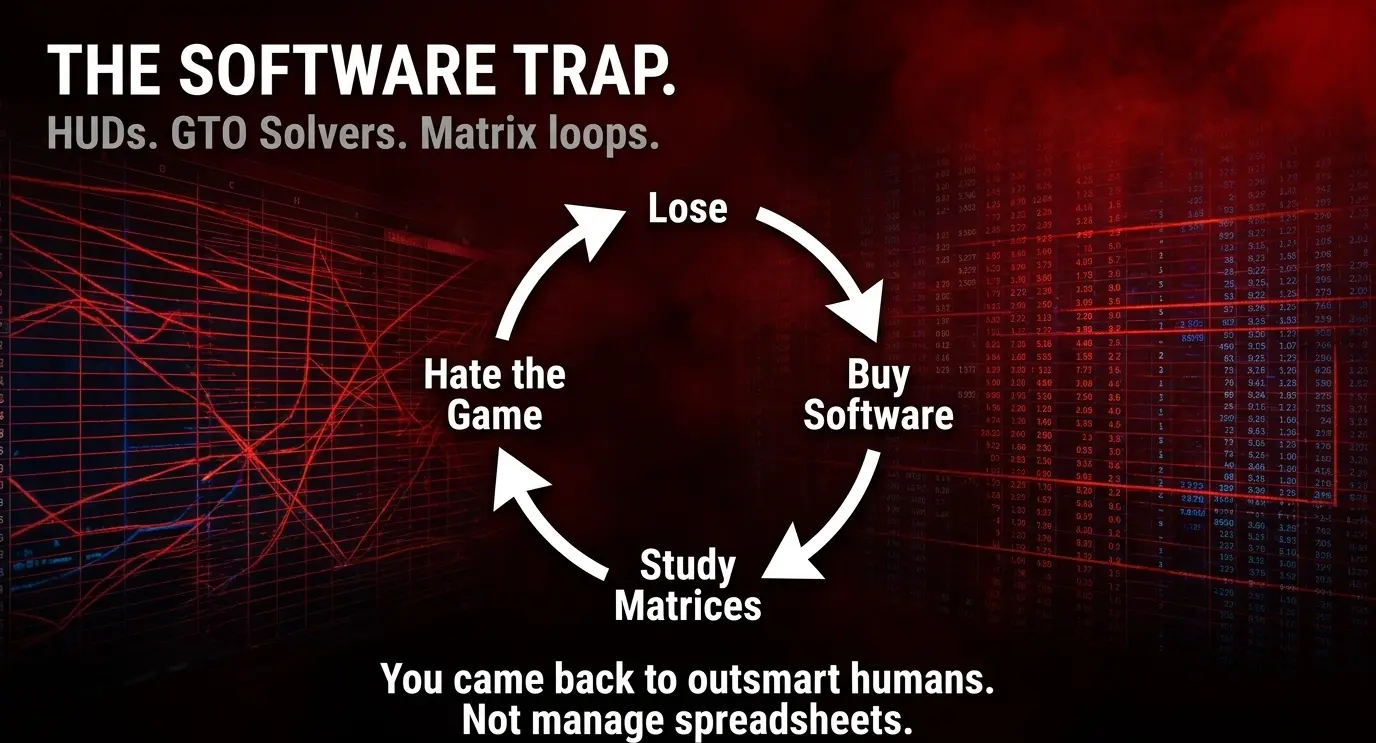
When players realize they can’t get their head around getting back into poker on mainstream platforms, their first reaction is always technology. They visit forums or subreddits and ask which software they need to buy to catch up.
All the newcomer expert advice they receive about getting back into poker is always the same:
- Buy a HUD (Heads-Up Display).
- Subscribe to a GTO (Game Theory Optimal) solver tool.
- Study advanced matrix loops for three hours per day.
But using software to fix your game by turning yourself into a miniature computer scientist kills the entire reason you ever loved this game. You didn’t come back to manage spreadsheets… you came back to outsmart other human beings.
How to Win Without Becoming a Robot
If you want to succeed, you need to lean back into real human exploitation. The math matters, but adjustments matter more.
1. Abandon Balance Against Casual Opponents
If an opposition player is playing 60% of their hands (VPIPs), do not worry about being “balanced.” Bet your strong hands for maximum value, cut down your low-frequency bluffs, and set your bet sizes high when you have good hands.
2. Exploit Timing Tells in Modern Mobile Apps
Players on mobile apps showcase extremely large amounts of information based on how fast they act. If they snap-check before raising, it means they likely have a weak hand intended for folding. If they wait for what seems like forever before making a river call, they probably can’t decide between a super elite bluff or a total fold.
3. Focus on SPR (Stack-to-Pot) Ratios
Loose app games cause the pot size to fluctuate very quickly pre-flop. Learning how to recognize when you have committed enough bankroll to the pot size relative to your remaining stack is way more important than trying to make a hero fold.
Choose the Right Room, Not the Harder Grind

You don’t need to become a data analyst to win at poker today. The old-school skillset — reading human vulnerability, manipulating pot sizes, and adjusting to wild emotional plays — still provides the most profitable edge for anyone getting back into poker today. You just need to use them where there are still humans left who are willing to let you exploit them.
The wrong room costs more than the wrong play.
Stop trying to force a 2003-style mindset into a corporate public machine. Put down your advanced solvers, step away from robotic public grids, and start getting back into poker through invite-only private club networks where digital cards equal human players.


